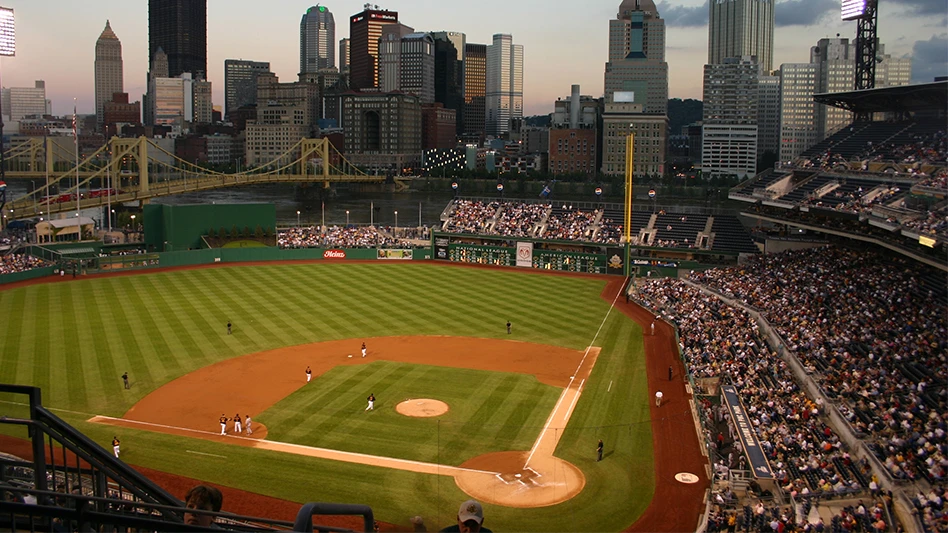

I have always been fascinated by ballparks. That’s certainly why I have been drawn to golf. The game is played on the most varied and the most interesting of ball fields.
The first team I followed, the hapless 1962 New York Mets, played their first two seasons in the Polo Grounds, a ridiculous, oversized shoebox. Even on TV, I could tell how different it was from windswept Candlestick Park in San Francisco or the suburban Southern California lawn look of elegant Dodger Stadium.
The first game I attended, in August 1963, was at majestic Yankee Stadium. It really opened my eyes to the grand possibilities of the craft. When Shea Stadium in my home borough of Queens opened in 1964 and I attended my first game there — on the Thursday following that season’s All-Star Game — I remember being thrilled by the scene (taking my father to his first ball game!) but feeling a bit alienated by the distant formality of the stands.
Little did I know then that it was the first step of Major League Baseball undertaking brand suicide by moving into formally symmetrical, multi-use stadiums for baseball and football, as seen in Atlanta, Cincinnati, Philadelphia, Pittsburgh and St. Louis. A generation or two of spectators would be denied the intrigue of a captivating stadium.
My interest was piqued. When I wrote to MLB asking for more information, I received some brochure diagramming in exhaustive details the data on each major-league ballpark. It didn’t just have outfield dimensions and seating capacity, but also the capacity of the adjoining car park lots, enabling me to draw the ballparks in scale. Which I did for hours.
I had already stepped onto my first golf course and, soon thereafter, caddied at local private clubs and played a few courses. I started diagramming holes on large sheets of oak tag, using a 12-inch ruler whose 305-millimeter scale provided the perfect proportions of one yard equal to one millimeter. I became the master of the short par 4 (305 yards!), and with my turn points on doglegs set at 250 yards, I drew many holes in the region to scale.
Watching golf on TV further opened my eyes to courses across the country and the world. Whether it was following the Sunday afternoon tournament telecasts or the winter Saturday afternoon airings of “CBS Classic” or “Shell’s Wonderful World of Golf,” I had a vast repertoire of fabulous courses to draw.
Decades later I’m still doing that, fascinated as ever by golf courses and ballparks. I don’t count the golf courses I’ve visited, though surely the total is several thousand. I have kept track of my attendance at various ballparks: 40 big-league ballparks (including three each in New York, Philadelphia and Pittsburgh), 16 NHL arenas, NBA games in eight different buildings and five different NFL stadiums. Each time I visit a new one I try to get there early, walk around as much as I can, and get a view of the field from the farthest seat possible, as well some nearer.
A similar sense of exploration animates my golf course tours, even the surreptitious ones. Golf courses differ from baseball stadiums in one vital respect: those fields, with all their quirks and asymmetries, provide a static platform for a game contested between teams. In golf, the player deals intimately with the nuances and character of the course itself. That changes from hole to hole, and from day to day — and even within the day depending upon weather and setup.
We saw an extreme version of that last month during the U.S. Open at Oakmont, where the course had already been reshaped and restored by Gil Hanse to expose its diabolical edginess. And then we watched as the playing surface changed dramatically during the final round thanks to a midday downpour that made the golf holes even more treacherous for those who wandered off the straight and narrow.
It’s that dynamic quality to the playing surface that makes me appreciate golf above all other sports. The golf arena is itself a player in the contest — or at least can be when the design and set up are interesting enough.
That’s also why I’ve always been interested in golf course superintendents. Their work has a unique engagement with how the game is played. The field is more than a mere platform. The game is at its best, such as during the 2025 U.S. Open, when the golf course is a central part of the story, when it demands the best of players and exposes their flaws under pressure. That’s when the arena gets interesting.

Explore the July 2025 Issue
Check out more from this issue and find your next story to read.
Latest from Golf Course Industry
- From the publisher’s pen: Respect the side hustle
- Super-Scratch events to expand nationally
- Beyond the Page 78: Labor solutions, AI talk and mayhem
- Construction progresses at The River Club
- VIDEO: A century of innovation
- Sentosa Golf Club preps next generation of turf pros
- Western turf leaders honored by GCSAA for advocacy efforts
- The Canary flies out of the mines