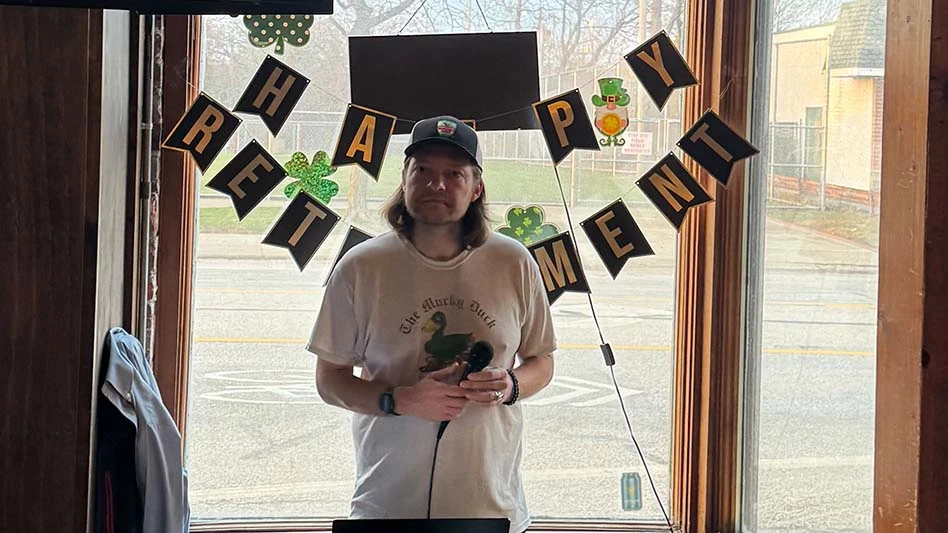
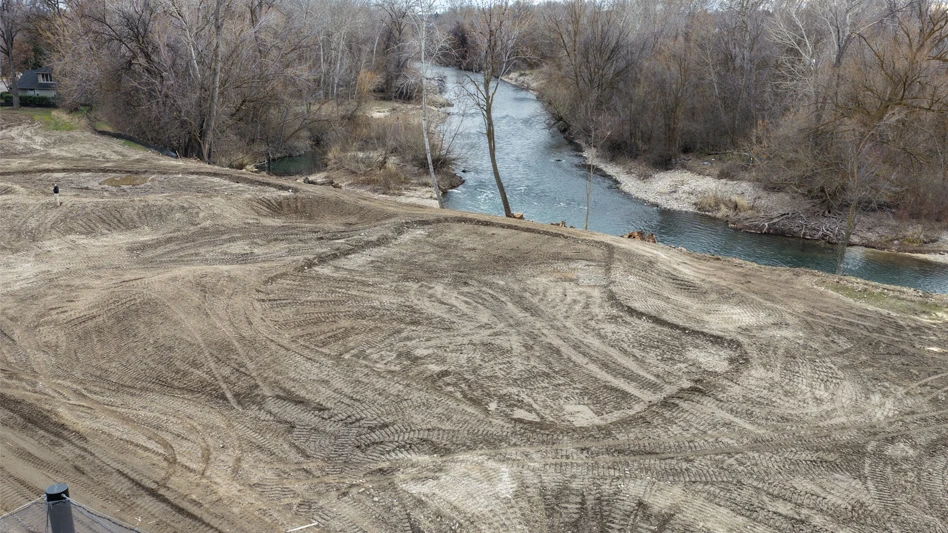
The screech of a white school bus’s brakes can be heard from outside Rocky Face Tavern, as students of Bethel Middle School filed out and sprinted to the turfgrass. An excuse to leave the classroom and go outside for a First Green field trip at Springdale Resort would soon introduce the sixth graders to career opportunities in the industry.
In the mountains of Cruso, North Carolina, the aftermaths of Hurricane Helene and even Tropical Storm Fred are still visible. Behind each student is a different story, one of possible devastation, home and property loss, months of recovering. But those memories were masked on the field trip with smiles, curiosity, questions and discovery.
General manager and director of agronomy Jeremy Boone was once a student at Bethel Middle School. The opportunity to welcome them to the property means a chance to give back to the community, alongside his staff, friends and community members,
Boone’s wife, Kelly Boone, is a former teacher and she let her educator experience shine while assisting with the water testing station alongside Preston Jacobsen, the executive director of Haywood Waterways Association. Boone’s longtime friend Adam Mis, superintendent of Transit Valley Country Club in East Amherst, New York, has traveled to North Carolina four times now to help. Mis led this year’s “cool tools” group.
Carolinas GCSA local association coordinator Kim Clark visited Cruso to show appreciation for Springdale and the growth of the event. Springdale’s director of golf Rodney Russell and superintendent Jack Hammer each led stations, Russell on putting and Hammer on irrigation and water conservation with Brandon Ingle of Mountaintop Golf Lake & Club. The Springdale staff’s commitment and energy to the experience revealed the positive work environment created at the resort.
Matt Layne and Brent Ward of Regal Chemical Company also made a visit to the event, leading a station on soil. Even the club’s kitchen staff participated, as food and beverage manager Page Truesdale taught students about the ins and outs of running the resort’s Rocky Face Tavern.
Golf Course Industry spent the morning shadowing the groups of students, observing their emotions and questions through each station. Following each of the six groups led to different revelations and takeaways from our team.

Marshmallows, cookies and joy
The man mowing the green where principles of irrigation were being explained in terms that sixth graders would understand kindly handed his fleece to a student in short sleeves. The boy slipped it on and smiled, shyly. Students thrusting the moisture meter into the ground and checking the readings smiled, too. The morning was cold, windy and indisputably filled with joy.
Shared fleeces and sunbeams falling on Cruso weren’t the only ways the morning warmed up. Springdale Resort director of golf Rodney Russell taught the students about putting — looking for the break and thinking about speed and distance. The students played alternate shot, and the cheers and the Phil Mickelson-style jumps for joy when the putt dropped after several attempts, were heartwarming.
Here were kids, maybe half having been introduced to golf and half experiencing it for the first time, starting to understand. The range of topics covered during their First Green field trip — playing, food and beverage, irrigation principles, cool tools, soils and streamflow — meant that different children were connecting with the material at different times. You could see when something clicked.
All credit to the adult leaders for their patience and for making things relatable. At each station, the adults asked and answered questions, keeping the mood light and informative, and redirecting the conversation when necessary.
To understand streamflow, the kids were split into groups of three. One student dropped a big marshmallow into the stream, one used a stopwatch, and one rescued the marshmallow seconds later. Together, they ran calculations using the order of operations (PEMDAS), equations and a little support. They moved on to the next station chewing puffy marshmallows.
For an area recently traumatized by flooding that has changed fortunes and stream paths, addressing water flow scientifically and sensitively was significant. Kelly Boone, an experienced teacher, helped at this station and her talents were on full display.
Superintendents and company representatives supporting this First Green event could see the impact of the hours spent together. Their conversations resonated with joy and smiles, too. It takes effort to execute effective learning — setting up tables and equipment, organizing the curriculum for stations, recruiting volunteers who can still manage their day-to-day responsibilities — but the goodness was palpable. The casual time together was wholesome for the adults, too.
Food and beverage manager Page Truesdale spoke to the children in the onsite restaurant, Rocky Face Tavern, about the front- and back-of-house and being “in the weeds” when the kitchen is a little behind. Early in the session she asked the students what they were learning at school that would help them in this working environment, and the kids had multiple ideas. The subsequent discussion covered concepts like teamwork, communication, reading for recipes and math for calculating quantities. She addressed responsibilities for entry-level jobs and how the servers have “homework” so they can introduce the specials. Jobs require ongoing learning, a great lesson. Students finished at this station by munching on delicious cookies as they took in the beautiful view on the back patio.
It was great to be there, participating in a few hours that enhanced the lives of those present in ways that were clear and in ways that have yet to be seen. It was a morning filled, importantly, with golf-based education but also with many moments of sweet gratitude and joy.
— Lee Carr

Money morning in the mountains
Trudging down a cart path bordering Springdale Resort’s creek-bisected ninth and 18th holes, a group of spunky sixth graders and observant adults braced for unknowns on a brisk, sunny early spring morning in western North Carolina.
Could jargony concepts involving soil and irrigation captivate children?
With mountain views surrounding the course as a backdrop, Matt Layne and Brent Ward of Regal Chemical Company led a First Green field trip station introducing the fundamentals of soil science. Layne described differences between synthetic and organic fertilizers, why turfgrass managers collect soil samples, and the relationship between sand and golf. Buckets of sand, silt and clay and tubes of granular product samples offered children a chance to play in the scientifically significant dirt. Instead of looking up at the Blue Ridge Mountains, gazes locked toward Layne and Ward.
Perhaps living among the mountains makes somebody immune to postcard backdrops. Or perhaps the purpose of a First Green field trip — which includes stoking curiosity in the practices and principles behind the golf industry — was quickly being realized.
A large part of that curiosity stems from career opportunities and finances. Layne fielded rapid-fire questions, including one about the income potential in the industry. “There’s a lot of cool careers,” said Layne, a former sports turf manager, “and you can make a good living.”
After hitting a few putts on Springdale Resort’s severely sloped 9-hole putting course, the children entered the Rocky Face Tavern, where food and beverage manager Page Truesdale explained the front-facing and behind-the-doors dynamics of a restaurant. Again, a student asked about earning potential. “If you want to get into this industry, you can make a good living,” said Truesdale, who runs the tasty tavern with her chef husband, Sid Truesdale.
The final stop for the group was Springdale Resort’s nursery green, which sits in a wide expanse between the first and ninth holes. One of Springdale Resort general manager and director of agronomy Jeremy Boone’s best superintendent friends, Adam Mis, traveled from Transit Valley Country Club in western New York to demonstrate mowing and cup cutting techniques, proving the industry’s camaraderie is more inspiring than its mountain settings. Affectionately called “Mr. Teacher Adam” by one student, Mis received a direct, yet important question …
How much money do you make?
“I’ve had a nice career and been able to support my family,” Mis enthusiastically responded.
Industry initiatives such as First Green expose thousands of children to golf and industry careers. Observing a few curious western North Carolina children pop the money question suggests those efforts will only be a success if an industry career allows people to support their families through professional passion.
More than science, scenery and scores, golf is about money. A field trip might bring the future workforce to a course for the first time. Curiosity and passion can lead to a job as a teenager.
The right numbers will accomplish the end goal: keeping them there as adults.
— Guy Cipriano

Curious kiddos
On a chilly 30-degree morning, nearly 90 sixth graders sprinted off the bus at Springdale Resort for a First Green field trip. Few of them wore jackets, some sported shorts and T-shirts, even flip-flops. But the outdoor conditions didn’t seem to stop them from going all in to learn about the workings of a golf course.
Following a group of students from station to station revealed a refreshing sight of excitement and participation. At each station, kids were quick to answer and ask questions and were greeted with equal enthusiasm from the leaders.
“Is this real grass?” a young girl asked as we walked up to the water conservation station on the 18th green. Students learned about water management and irrigation systems on the course, answering questions about the water cycle.
Due to brisk temperatures, one wouldn’t expect any student to be willing to get hit by the sprinklers. But when posed with the option, numerous boys ripped off their sweatshirts, ready for superintendent Jack Hammer to test out the irrigation system.
Thankfully, only a sprinkler on the other side of the green went off. But the kids’ anticipation and excitement to go all in despite the cold air was heartwarming.
During the kitchen station inside Rocky Face Tavern, students responded to questions about teamwork and math, and their curiosity for peering inside freezers guided them through. But nothing got them more excited than ending the session with homemade chocolate chip cookies.
Every kid walked into the teeth-chattering freezer despite not being anywhere near dressed for the temperature. They walked by whiteboards with encouraging kitchen mottos written on them, asking questions about everything they saw.
At the following station, students could barely wait to drop their marshmallow in the river, examining flow speed at the water testing station. Using a timer, another member of the group snatched the marshmallow moments later, and together they used their math skills and equations, along with leadership guidance to calculate the speed. Although they were on a field trip, the students were not hesitant to put their mathematics to the test.
At the “cool tool” station, students surrounded the green, engaged as Transit Valley Country Club superintendent Adam Mis demonstrated cup cutting and turned on equipment. Students jumped at the opportunity to sign a flag at a nearby table and observed the other equipment items on display.
At the soil station, the students were so curious to study the different soils, Matt Layne and Brent Ward of Regal Chemical Company had to ask them numerous times to step back from the table.
As I followed the students through each station, I could only admire the teachers who led the groups around the course. It’s clear they have helped teach their students about the importance of curiosity and participation.
— Kelsie Horner

Do it yourself
Not long before Jeremy Boone arrived at historic Langston Golf Course in Washington, D.C., in the early 1990s, neighborhood kids would sneak onto fairways and greens, pilfer balls still in play, then sell them back to the golfers who had hit them moments earlier. That practice stopped after course manager Wallace “Sarge” McCombs hired many of those same kids to work on the course. Boone later welcomed the next generation of kids who lived around the course to come visit.
“We invited kids from across the street to learn about maintaining a golf course and playing the game,” Boone says. “It was simply allowing inner-city kids the opportunity to be in a green space.”
McCombs’ and Boone’s efforts pre-dated the official launch of First Green in 1997, but they were in line with many of the goals of the program specifically and the GCSAA in general:
- Provide wildlife habitats amid increasingly urban areas.
- Inspire students to dive into STEAM education and, perhaps, careers.
- Share the environmental benefits of golf courses with folks who likely don’t know — and might have never visited a course.
First Green bloomed during Boone’s years away from the game. He detoured into web sales and the lawn and garden department of a local Lowe’s, then managed four independent hardware stores before returning to golf in 2019, just after the GCSAA took over the program. And when he first learned about it, “I immediately wanted to participate.” He started with “hours of reading,” then attended a First Green field trip seminar at a GCSAA Conference and Trade Show.
Boone admits to “jitters” before his first event at Springdale Resort — where he was promoted in October 2024 from golf course superintendent to general manager and director of agronomy — but now, after hosting four events, he needs just a few hours of prep.
Want to follow Boone’s path and host First Green events at your course? Leann Cooper, director of First Green and workforce development for the GCSAA, recommends registering to host an event at thefirstgreen.org, then connecting with a local school and registering the event online to receive GCSAA assistance. Beyond those first steps of research and conference education, you’ll need a little help from your friends.
“This is not a one-man operation,” Boone says. “I’ve had help from Don Garrett” — superintendent of the Walker Course at Clemson University and a First Green mentor. “My buddy Adam Mis from Buffalo comes down each year. My wife, Kelly, is a retired math teacher, and she handles stream flow calculations.” Preston Jacobsen, the executive director of Haywood Waterways Association chips in, too, “along with many other industry members who help make our event a special day for the kids.”
Boone has welcomed more than 300 students to First Green field trips at Springdale, and the number of field trips and students on course across the country has increased every year since 2020 — from 27 trips and 1,498 students in 2021, to 109 and 6,789 last year. And the GCSAA is shifting the focus from elementary and middle school students to high schoolers.
“Because the end goal for First Green is to help create interest in the career path,” Cooper says. “It’s a great community outreach program. I love that the kids get to come out to a golf course and experience a wonderful learning setting with no walls. It’s a classroom outdoors. And we do want more people to go into the profession — or at least have a favorable impression of what golf course superintendents do every day.”
High school trips tend to be smaller, about 20 to 30 students. “You can make a deeper connection on what that student is interested in,” Cooper says. “They’re able to understand more of the science, the engineering, the technology behind things — the why, not just the what.”
And much like how McCombs hired those one-time ballhawks, Cooper says she has heard some superintendents even have seasonal employment applications in hand during their event. Seems like the start of a solid career path.
— Matt LaWell

Explore the June 2025 Issue
Check out more from this issue and find your next story to read.
Latest from Golf Course Industry
- VIDEO: 'It's their livelihood'
- Reel Turf Techs: TJ Vollmar
- Bernhard and Company names G.C. Duke as North American Distributor of the Year
- Course at Sewanee picks KemperSports for management
- WiTricity expands wireless charging technology
- Shining star
- SiteOne Landscape Supply acquires Reinders
- Talking Turf Weeds 17: Waking up your course after winter with Yusif Jaouni and Matt Herrmann