Last summer, while driving home from a splendid golf weekend in New Jersey, my playing partner and I passed over the Piscataqua River Bridge, back into Vacationland, just as the Golden Hour began to spread its gauzy light and lengthening shadows across the Maine Turnpike.
On Sunday nights in the summer, most of the traffic on I-95 is heading south, back to more densely populous, recreationally desolate areas. But Michael and I were headed north and traffic was light. Newly widened to three lanes on either side, this southern portion of Interstate 95 had never looked quite so good — its jet-black corridor flanked by native grasses shimmering in the late-afternoon sun.
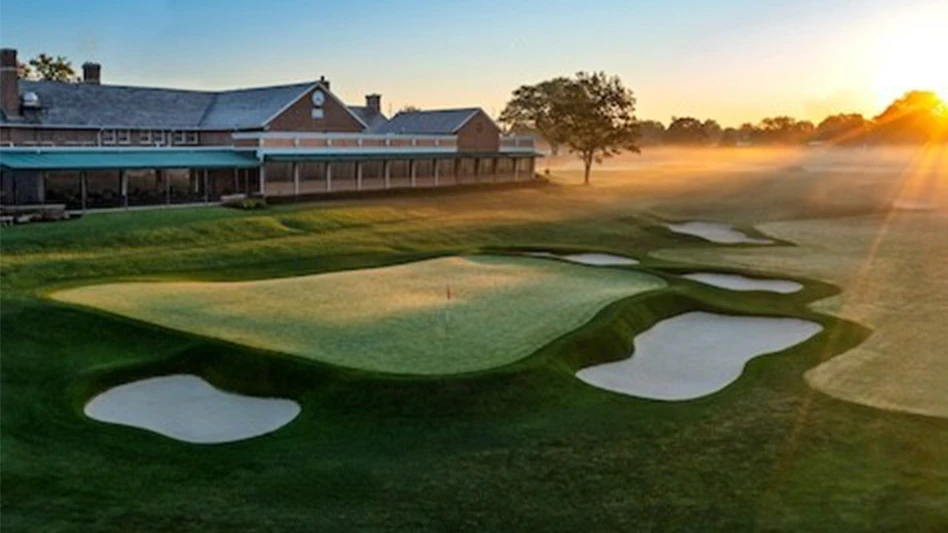
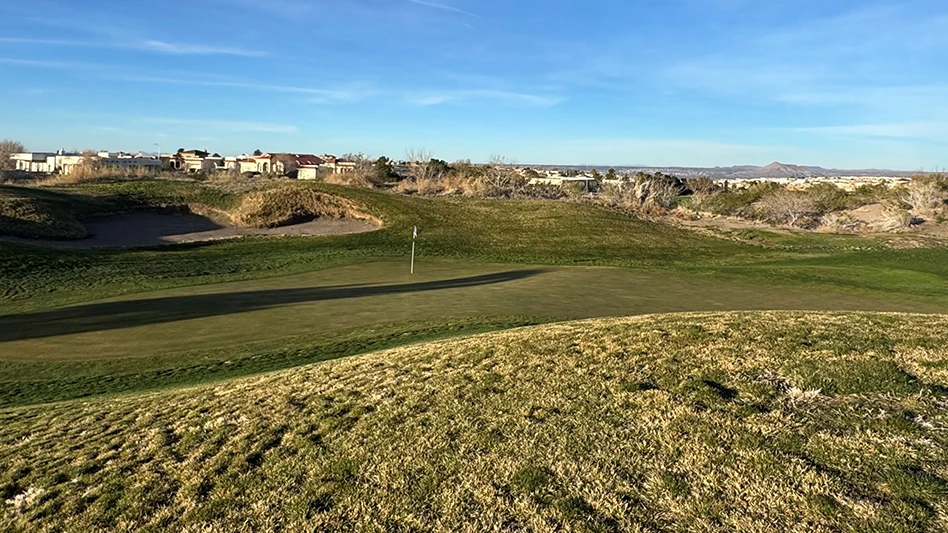
Just that morning the two of us had played the Lower Course at Baltusrol Golf Club, one of a growing number of parkland courses that has cultivated stands of fescues in outlying areas. The day before, we had visited Hollywood Golf Club on the Jersey Shore, where equally colorful banks of fescues and little blue stem framed up the golfing space — even more convincingly, it could be argued, hard by the Atlantic Ocean.
With so much fescue on the brain, I ultimately bade Michael to pull over — to examine the varieties so warmly bordering these six lanes of highway. And to get some pictures in the soft light. Eager to get home, he refused. Later, in the fall (with no one in the car to refuse me), I pulled onto the shoulder just north of Portland, where the flaxen swards were still beautifully arrayed at Pikeside — but only from a distance. A bit closer up they revealed themselves to be thinner, as a proper patch of fescue should be. Getting back in the car, I resolved to find out what the Maine Turnpike Authority had specified for its particular fescue program, and whether these were the same varieties being cultivated on so many inland, parkland tracks, where such a thing would never have been considered 25 years ago.
Then it occurred to me that course superintendents would be uniquely equipped to comment on those highway-grassing choices. So, I got ahold of those specs. Here they are:
- Red fescue, 50 percent
- Little Bluestem, 15 percent
- Indian Grass, 10 percent
- Red Top, 5 percent
- White Clover, 10 percent
- Annual Rye, 10 percent
Without revealing the application, the above information was then shared with Michael Broome, the aptly named superintendent at Hollywood Golf Club. My playful ruse lasted about 45 seconds on the phone. Broome quickly deduced exactly what he was looking at — which lessened his interest in this turnpike-swaddling fescue trend not one iota.
“They’ve been brining highways for years. That’s what’s creating a less-rich soil — and the fescues love that,” Broome says. “We don’t want it too thick either. In a parkland setting, we’re often converting rough areas that had been fertilized for 100 years. All that fertilizer our predecessors put down ahead of us: It’s still in the soil. A lot of the best fescue is found at seaside courses because the soil is just sand — no fertilizer left over and lots of salt. So, if you think about it, a perfect use on the roadside.
“The whole thing about fescue is you don’t have to water it. If you don’t water a plant, it will push roots deeper looking for water. But as they go deeper, they continue to mine nutrients that have been there for a hundred years. At seaside those nutrients aren’t there. And that’s the definition of links, right? Built on land you could not farm, would not farm, because there are no nutrients! That is why you put a golf course on there.”
This information cleared up another links trope: Yes, the sheep might have grazed the land in St Andrews and made it easy for 18th-century Scots to find their featheries. And yes, where sheep burrowed into small hillocks to escape the wind in 1750, we may find bunkers today.
But the sheep were there because the land was not arable.
“Linksland wasn’t farmed because the soil has no nutrients in it,” Broome further explains. “Sand is a good growing medium, but that growth won’t last. Unless it’s something like a fescue. On a parkland golf course like this one (and that’s really what we are), we were fertilizing with manure for decades and that stuff is still down there. And these plants go and get it.”
I’ve been working in the golf business, writing about course maintenance and design, since 1992. When Sand Hills opened in 1995, then Bandon Dunes a couple years afterward, if you had told me that parkland golf courses in 2025 would be framing fairways with stands of fescue, I would have laughed you out of the room.
But such has been the impact of what I call the Sand & Scrub Era, a neo-classical, ostensibly links-inspired but largely inland movement that seeks to reinstate the primacy of seaside golfing qualities after decades of rampant parkland development — and irrigation, which, in the years following World War II, quickly turned what had been firm, fast inland courses into lush dart boards.
Some underpinnings of this modern sand-reliant movement are performance based. See sand-capping (something else we’d have largely dismissed, back in the early 1990s, as both impractical and agronomically unnecessary). But let’s be honest: Sandy soils also produce better turf. They produce better playing conditions such as the bounce and roll that linksy features require to perform their functions.

Fescues are different. They perform no function that isn’t ornamental because, try as they might, modern designers and superintendents aren’t building and maintaining huge swaths of fescues that are regularly burned off to perform as actual rough areas. That’s a seaside thing, and it’s largely a U.K. thing.
In that way, the aesthetics at play in New Jersey and elsewhere are more stout proof of this relatively new way of thinking about how North American golf should look and play. The trend started slowly — with the odd, late-90s track that chose to create eyelashes on its tee-facing bunker edges. Today, any upscale parkland course worth its salt (pardon the pun) maintains a fescue program.
How broadly popular has this trend become? Well, they’re maintaining fescue programs along the Maine freakin’ Turnpike!
• • •
But here’s the thing: While fescue programs along interstate highways may seem faintly ridiculous, those collections of little blue stem and red top actually perform a function. On golf courses? Not so much and, to be clear, this trend does not inspire warm, fuzzy feelings among golf course superintendents.
Even so, superintendents generally agree that stands of fescue and other “native” grasses look pretty darned good. The color contrast alone, when set against verdant fairways, remains viscerally pleasing.
When I actually called Broome to chat about the Turnpike Seed Mix (yeah, that’s what we’ll be calling it — even if Maine Department of Transportation folk call it the “Method 2 Mix”), I was a bit worried the superintendent would question my sanity. He didn’t do so directly. Then he very much warmed to the task.
“You are really going down the rabbit hole with this,” he said, “but it’s funny to me that you notice these things on the roadside. I travel a lot, too, and I wonder myself, ‘How does it look so perfect?’ But if you slow down from 65 to zero, not so much. And that made perfect sense to me. The fescue that looks great — on a golf course — doesn’t play great and vice versa.
“Fescues are popular now because golfers love a good, thick, homogenous stand — it’s that contrast they are responding to. But where you can’t see your shoes or advance your ball? Thick isn’t good for that. Fescues on bunker banks are common here. You’re looking straight into it most times. To maintain playability, you need to have it thin — to play out of it. It’s a balance, and the golfers are no help. Some guys are like, ‘Oh, the fescue looks terrible,’ but next group says it’s playing perfect. Fescue is a fickle mistress.”
And golfers are no better.
In reality, the Turnpike Mix is nothing like what Broome and his colleagues are seeking and maintaining on golf courses, not in our 21st-century High Fescue Period. Architect Brian Silva, who started out as a USGA agronomist, looked at the Turnpike Mix and confirmed this.
“The seed mix for the highway work is a bit different from many used on low-maintenance areas on courses with the red fescue, clover, red top, Indian grass inclusions, etc.,’’ Silva says. “No doubt it’s better for the application than the more wispy, fescue-centric mixes used on courses. Red top and annual rye are clearly ‘nurse’ grasses to help along the others in a non-irrigated situation.”
Broome was also struck by that lack of fescues. “There’s only one fescue listed there!” Whereas his Hollywood mix features four: hard, sheeps, red and chewings.
“Little blue stem is naturally occurring here, so we have some of that,” he adds. “Every once in a while, there’s a plant about a foot higher than everything else. In August, it’s green. We mow around it. It’ll go dormant in September and stay there all winter. I’ve never introduced it to the property. It just showed up and it looks kind of neat in terms of context and texture.
“Looking at the Turnpike specs: If we used this amount of little blue stem — 15 percent by weight, I’m assuming — in the course of two to three years, it’d take over our whole property. In 2024, we probably had 500 plants on property and that’s doubled in the last year.”
The Turnpike Mix that I first noticed driving back from Hollywood was deployed to control erosion during highway widening. Still, it was fun to hear Broome riff on why exactly some were included, compared to others.
Red Top: “Same as creeping bentgrass but not playable at this length obviously. This is more of a ground-cover blend and Red Top grows stolons, then pops up. That stabilizes the ground. Makes sense.”
White clover: “We go out of our way to kill that because we consider it a weed. But it will grow in undesirable ground conditions where nothing else will. Could also be a salt-tolerant component in that mix.”

Annual rye: “The fastest to germinate. When they make seed application to bare ground, they want something to catch before it dies the first year and never comes back. It’s a sort of sacrificial lamb, but it’ll germinate immediately within five days. In a perfect world, it will germinate, root and protect until the rest germinates and roots into the ground.”
Broome was frank: “Every superintendent with fescue will tell you they hate it. It’s a pain. It’s always too thin or too thick, and anywhere the sun can hit the soil, you have weeds. We spray two different pre-emergents, weed preventers, in the spring and late fall. We use selective herbicides throughout the year to weed out crabgrass, nutsedge, clover, goosegrass, even some Bermuda we get here.
“Seems clear to me they chose this [Turnpike] mix as a ground cover to stabilize that ground, hoping the blue stem and fescue would take over and give it an aesthetic quality… I was wondering about salt spray: Personally, I really want to get salts onto my fescues. It helps to thin them out. Typically, I’d think the medians and the shoulders are designed to take all that surface water. So, those areas getting watered by [salty] runoff all the time.”
• • •
Turns out, golf industry professionals were applying a bit too much agronomy to the choice, makeup and deployment of the Turnpike Mix.
“What we call the Cottage Mix, or the Method 2 Mix, is standard in contract documents for DOT and the Maine Turnpike,” says John Cannell, director of maintenance for the Maine Turnpike Authority. “What we’re primarily trying to do is simple: stabilize the soil for erosion control before during and after construction. We’re trying to nail that soil down so we don’t get the rivulets eroding the soil and washing it off into the watershed.”
According to Cannell, the folks managing agronomic matters and erosion control at the Maine Turnpike Authority didn’t study at Penn State. They generally come to the table with certain skills and educations, whereupon they learn the rest on the job. Or defer to someone who knows more agronomy than they do. For example, Maine’s Method 2 Mix was developed by the aptly named Bob Mooseman, a longtime DOT employee who specialized in shrubbery.
Cannell himself is no agronomist, but he knows the Turnpike Mix “grows well in our climate, at roadside, and it’s easy to maintain… It wouldn’t surprise me if we threw something in there for salt tolerance, but I just don’t know.
“What I can tell you is that we’re judicious in the way we use salt, and this is my forte. We’re really careful about how we apply salt, at the right time and amount for the time of year. That means taking into account weather temps and road temps. Once we have that, we can calibrate pounds per lane mile. We have ways to make salt stick to the road and work faster — to make sure the road gets the salt, and the salt goes only where we want. Salt is exponentially more effective at higher temps. At lower temps, you have to use more salt but that’s not a linear relationship. It’s complicated.”
Gustave Nothstein is statewide vegetation manager for the Maine DOT. He’s a man of few words, and not a golfer (“Haven’t played for years”). But when I told him that golf media and course superintendents were interested in his fescues and other varietal choices related to the 2023 road widening, he perked right up.
“These are cold-weather grasses that do well in very poor soils. They’re salt tolerant. They’re fire resistant. A lot of them grow by rhizome, meaning they spread out and form new plants via the root systems. That’s a benefit for us because they form a nice thatch layer and some of those new areas won’t need to be seeded.
“The mix we use is designed to be good anywhere within the state — and we have vastly different conditions in the state. It must do well next to trees, in acidic soils, in salty conditions directly next to the road. Conditions can change greatly in a mile’s span. Go back just a bit further from the road and you have a whole new agronomic condition.”
Nothstein also explained that specs are specs. What was actually specified to control roadside erosion during preconstruction bidding isn’t what actually got laid down starting in 2023.
“We use redtop in our mix. It does well for salt tolerance. Go along Interstate 95 and you’ll see it next to the road. But we’ve replaced it in our recent blend. Just a few years ago, there was massive drought where a lot of our seed was grown. (Ironically, they were supposed to do well in drought!) Red top was one of the ones we lost. Couldn’t get it for a while. Some of the fescues had an issue with supply, too.
“Little blue stem and Indian grass are no longer used specifically. We use the red fescue 35 percent and we use a hard fescue 35 percent, too. So, that’s really the formulation we used for the widening [in 2023-24]. My predecessor was all about lawns; prior to his DOT work, he maintained lawns. So, the white clover and red top were his idea. Our soils are bad; clover is a nitrogen fixer. But we’ve reduced that percentage and we use a bit more annual rye these days.
“More or less, that’s our current mix. Extremely low maintenance. We mow ’em once a year. That’s it.”

Explore the November 2025 Issue
Check out more from this issue and find your next story to read.