Advances in and application of the latest tech need not be limited to the metropolis.
Rather, bit by literal bit, automation and mechanization are finding fairways long narrated by pastoral privacy and abundant wildlife.
At CDA National Reserve in Coeur d’Alene, the Northern Idaho high-end club’s 1,000-acre lakeside property that abuts 5,000 acres of additional wooded landscape, a recent pairing of elk and autonomy is seeing the turf frontman reexamine a traditionalist’s purview.
A philosophy bucolic is understandably befitting the bounty of the Tom Weiskopf-designed grounds.
“It’s pretty rural out here, and no shortage of wildlife,” director of agronomy Zach Bauer says. “This past winter, we were over 200 head of elk on property; and then we see quite of a bit of moose, mountain lions, foxes, coyotes, bald eagles, ospreys and a ton of white-tailed deer. There’s also the occasional bear.”
Such fauna has recently welcomed a new, battery-powered pal.
“The funny thing is, I did a podcast in the spring, talking about how I’m more old school in regard to my turf management,” Bauer continues. “I really haven’t taken the full step into technology with data collection and things like that, but on the show, I was joking about that because my autonomous mower was literally just getting delivered, and I had just bought a GPS sprayer that was delivered the week before.”
Balancing his classicist’s mentality with future tools, Bauer has long had his eyes on robot options.
“I’ve been really intrigued by autonomous mowers for years,” he says. “I remember when Cub Cadet came out with their autonomous greens mowers more than a decade ago, and I was interested by that. And then the smaller robots started becoming available, and I was even more interested, but not quite, ‘All right, this is the way it is now.’”
The “way it is” occurred by a degree of happenstance.
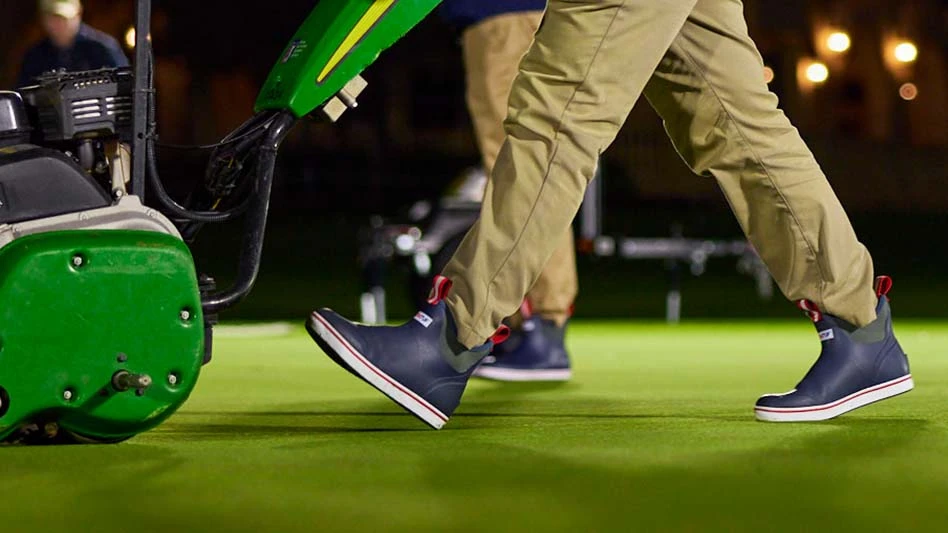
“A couple years ago at the GCSAA [Conference and Trade] Show, I saw FireFly [Automatix] at a booth in the back of the room,” Bauer recalls. “Seeing the full fairway mower stopped me in my tracks. We talked and they told me that they actually scaled the mower down to a 100-inch, 5-gang fairway mower from their large, sod farm mower. And I was like, ‘All right, somebody has figured this out. Sweet.’”
Sweet soon led to tangible.

“They offered to come out here for a demo and we kept in touch,” Bauer says, “and then they came out in July of last year, and I invited all the superintendents from the area. And I was incredibly impressed with the machine.”
Saying he “lucked into” his autonomous mower with timing of an expiring lease for previous machinery, CDA nabbed its first autonomous fairway unit in April. Fast impressed by the cut and noting a brief learning curve, the machine’s lone encumbrance came by way of a rurality signal issue.
“We understood that there were a few of our holes that we wouldn’t be able to get, because we just get no cell coverage on those spots,” Bauer says, noting he initially used Verizon Wireless with the mower, working off the RTK cellular satellites. “FireFly saw that too, so we went ahead and upgraded the machine to Starlink.”
Stronger signal acquired, Bauer and his team have been fast won over by the mow.
“Unlike a manned mower, where you might have a different person day to day, this mower turns in the exact same spot every single time,” he says. “It’s all pretty cool, pretty wild stuff.”
Such positive impressions have echoed across the CDA National clubhouse.
“I think it’s been a fabulous addition,” director of golf Gabriel Dorosh says. “From the golfer’s perspective, the stripe on the course can be consistent on every single hole, regardless of hole direction.”
Akin to club brass and supers across the country, CDA doesn’t see robots replacing humans, but rather liberating biped staff.
“I know from Zach’s perspective, it’s nice to have a member of his team freed up to do something else,” Dorosh adds. “It’s just more efficient. You’re not taking away labor, you’re actually getting more projects done in a shorter amount of time.”
Along Bauer’s cut lines, Dorosh needed some “win over” in the move to autonomy.
“I’m half traditionalist, half not,” he says. “I like to look forward and see what’s coming, but with a little skepticism. I don’t want jobs taken away, and if that ever starts taking place, then we can worry about it. But with this mower technology, I don’t see that happening.”
The success of one robot has CDA discussing an autonomy enhancement.
“I’d definitely do another one,” Bauer says. “I know that FireFly is getting a rotary version of the same machine and, if that’s the case, I’d certainly be interested in doing that on the driving range. The sheer size of our range, which might be the biggest in the state, it can take up a lot of resources, so the autonomous mowers would be really nice to have there.” For a turf traditionalist, Bauer’s scales are starting to see a future tilt.
Per his new Frost, Inc. GPS sprayer, the agronomist is experiencing a specificity meeting his métier.
“I really wanted a GPS sprayer for even longer than I’ve wanted an autonomous mower,” he says. “I just want everything to be very exact. In golf, of course, we’re spraying round surfaces with a square boom, so now, with the amount of chemical or fertilizer, it can be a lot more exacting. It’s interesting to see how much area I’m not spraying anymore.”
Working amid the pastoral postcard of ceaseless flora and Lake Coeur d’Alene shoreline, Bauer’s old-school setting has opened the door to a new classroom. Soon, further study of water usage by way of microwave technology, AI and data points may find room in the shed. The question is thus begged: Is Zach Bauer now Old School or New School?
“I’m both,” he says, following a considered pause.
Such a transition is a balance of craftsmanship and forethought.
“I remember back when doing any type of moisture management on greens, you’re using a soil probe or walking with your feet and looking for wilt. And then moisture meters came out, and that changed the game,” Bauer concludes. “Now, I couldn’t imagine doing it without a moisture meter. So, like a lot of guys, I grew up on the business doing it old school. But now I’m both. It’s science, but with an art to it.”

Explore the August 2025 Issue
Check out more from this issue and find your next story to read.
Latest from Golf Course Industry
- From the publisher’s pen: Respect the side hustle
- Super-Scratch events to expand nationally
- Beyond the Page 78: Labor solutions, AI talk and mayhem
- Construction progresses at The River Club
- VIDEO: A century of innovation
- Sentosa Golf Club preps next generation of turf pros
- Western turf leaders honored by GCSAA for advocacy efforts
- The Canary flies out of the mines