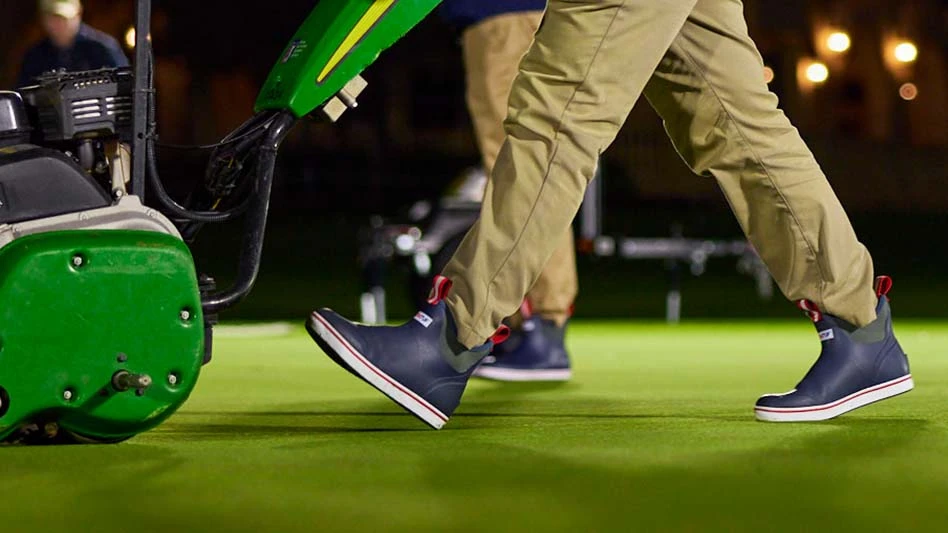
Manufacturers Golf and Country Club and its 2 ½ acres of Poa annua and bentgrass greens remain open throughout the entire year, presenting challenges to turf health.
With Poa’s resistance to all types of weather, superintendent Andrew Shaul jokes he and his team “babysit” the Poa surfaces on the William Flynn-designed course.
“Once you take your eye off it, it starts acting up,” he says. “We’re constantly on the greens, we know what’s going on and we just make daily adjustments for our maintenance practices.”
During the summer, the team “constantly babies” the Poa on the suburban Philadelphia course, especially when the heat increases.
The Poa is also vulnerable to fast-moving diseases like Pythium and gray leaf spot, so Shaul and his team follow a preventive spray schedule that he learned from former Ohio State University turfgrass professor Dr.Michael Boehm.
“He would always say, ‘An ounce of preventives are worth a pound of curative,’” Shaul says. “So, we found that out, we can stay on a preventative schedule and just try to manage that way.”
The course fertilizes the Poa in the winter, aerifies in late fall to help with drainage and applies topdress for protection.
“We view it as how we go into the winter is how we’re going to come out in the spring,” Shaul says. “My staff will spend a lot of time late in the fall sodding, plugging outfits areas, if there are any. Just doing everything we can to prepare.”
How the team takes care of the greens in the fall becomes important during the winter when the course experiences “wear and tear” from member and guest play.
“One big thing is here in Philly, they play a lot of golf. They’ll play golf in the winter,” Shaul says. “There’s not snow on the ground, they’re out here playing.”
The course also has greens ranging from different ages including over-100-year-old push-up greens, making it difficult to balance firmness and playability.
The “balancing act” of preventing high, unplayable speeds includes limiting hole locations once speeds reach 12.
“I think that’s kind of where the art and science of what we do comes into play,” Shaul says. “We have to watch it and manage it. We don’t want it to be silly and Mickey Mouse golf out there.”
Moisture meters are used to assess the performance of the greens, as Shaul places an emphasis on managing aeration. For helping the greens drain, they use an XGD drainage system and a drill-and-fill process.
“The aeration practice, that’s really helped the performance of the greens,” he says. “That data is pretty much key to us and how we’re managing it.”
An outdated irrigation system means Shaul and his team spend abundant time nursing the greens.
“We probably spend approximately 120 man hours a week just maintaining the putting surfaces alone,” he adds. “So, that’s going to include everything from mowing, rowing, cutting the cups, watering, topdressing, venting, spraying.”
With the challenges of operating a course that doesn’t close, Shaul remains eager to continue to learn how to improve.
“Stay humble, things are going to change, things are always going to be out of your control,” he says. “The weather holds the ultimate trump card, so you have to manage according to the weather, and that’s, I think, the biggest thing that we can do as superintendents.”
- Adriana Gasiewski



Explore the September 2025 Issue
Check out more from this issue and find your next story to read.
Latest from Golf Course Industry
- From the publisher’s pen: Respect the side hustle
- Super-Scratch events to expand nationally
- Beyond the Page 78: Labor solutions, AI talk and mayhem
- Construction progresses at The River Club
- VIDEO: A century of innovation
- Sentosa Golf Club preps next generation of turf pros
- Western turf leaders honored by GCSAA for advocacy efforts
- The Canary flies out of the mines