Steven Aspinall keeps an eye on his lucky stars. He feels blessed. He thanks God.
“My insect problems aren’t that bad,” he says. “And this is kind of new for me.”
Aspinall is wrapping up his fourth full season at Watchung Valley Golf Club in Watchung, New Jersey, where he was recently promoted from golf course superintendent to director of agronomy. He has worked at seven other golf courses over the last 21 years, and everywhere — Saratoga Golf & Polo Club, Morris County Golf Club, Preakness Hills Country Club — he has spotted and diagnosed and treated something. But for now, at least, “I don’t have many,” he says. “I really don’t.”
Aspinall arrived at Watchung Valley — located about 25 miles west of Staten Island and about 75 miles northeast of Philadelphia — in October 2021. Those early months were filled with annual bluegrass weevils, always his biggest insect issue. Over his first couple seasons, he developed an application program that ultimately included Tetrino insecticide, which he says “has been incredible,” along with a mix of other insecticides and insect growth regulators. “They’re game changers,” he says. “Absolute game changers for me.” The more focused approach has all but eliminated ABW larvae damage and has helped him drop his annual application count from seven to “two, maybe three.”
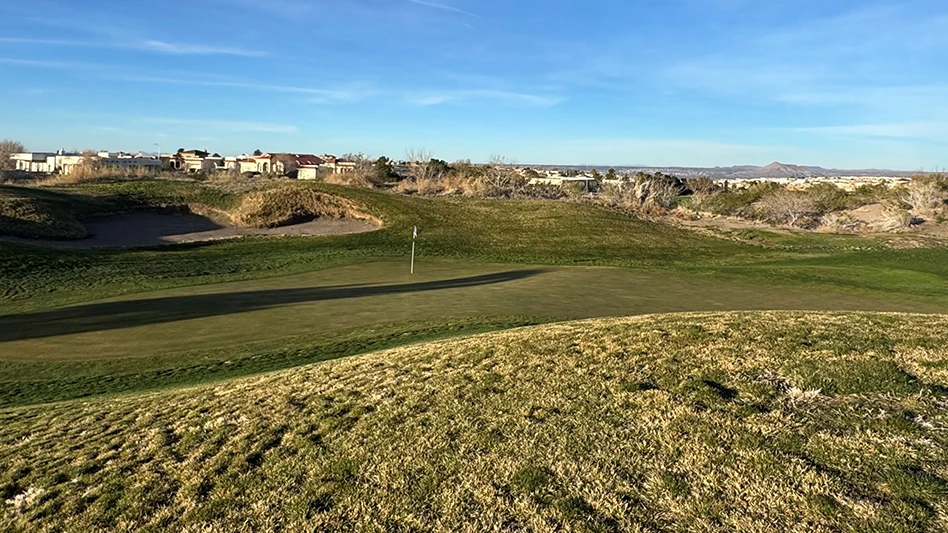
Aspinall often wonders whether his recent success is because of that blend and application schedule or because of Watchung Valley’s unique position: Much of the course sits on a south-facing slope atop hard soil largely free from trees. Temperatures at the course are cooler than other area courses, insects struggle to crawl beneath the surface, and there are no trees for overwintering.
“Why am I not dealing with this?” he sometimes asks himself. “What am I doing? What’s the environment here? I don’t know if the really hard soil plays a factor, that they literally can’t get into the clay.
“I’m not an entomologist. I don’t understand what they’re doing or why they do what they do. You thank your lucky stars you don’t have to deal with this as much as other people do.”
Aspinall is quick to acknowledge that his current situation will likely not last forever — or even beyond this season. He thinks about insect lifecycles and whether future generations will be born immune to his current multi-product approach. He says he’s nervous that, at some point, it will stop working.
“There’s always different things coming,” he says. “We have the spotted lanternfly. That just kind of popped up when I got here and they were really bad. I didn’t know what they were or what they were doing. Nobody knew. … The predator insects didn’t know what these things were, either, but there are fewer of them now than there were four years ago. The praying mantis and bats and frogs all realized these are edible, and Mother Nature is taking care of it in a way.”



Explore the October 2025 Issue
Check out more from this issue and find your next story to read.