sponsored by


After spending more than 30 years in the industry, regional director of agronomy Eric Johnson has learned a thing or two about adaptability. That skill has gotten him through many challenges, and especially the year of 2025. Johnson graduated from Oregon State University in 1995 and was hired at Chambers Bay Golf Course in 2012.
The Washington facility stays open year-round, so the tee sheet stays full consistently — even in the winter. Instead of having the off-season for maintenance projects, the course closes every Tuesday from November to February to allow for the turf team to complete focused tasks. Even on crappy weather days, Chambers Bay stays busy.
“Once the first tee time goes, they’re right on top of each other and then chasing us,” Johnson says. “Once the golf course is full, it’s pretty challenging for us to get out in front of play to accomplish anything.”
With an influx of golfers, high traffic areas require more upkeep. “We don’t have a lot places to move people off of traffic areas, so a lot of those tight focal points get beat up,” Johnson says.
Johnson adds communication is key for getting through the busy seasons. “The biggest thing is to communicate within your property and all the weekly managers going on with that department — trying to plan as far as possible ahead on things with traffic and staffing and all that stuff,” he says. “That’s our No. 1 goal.”
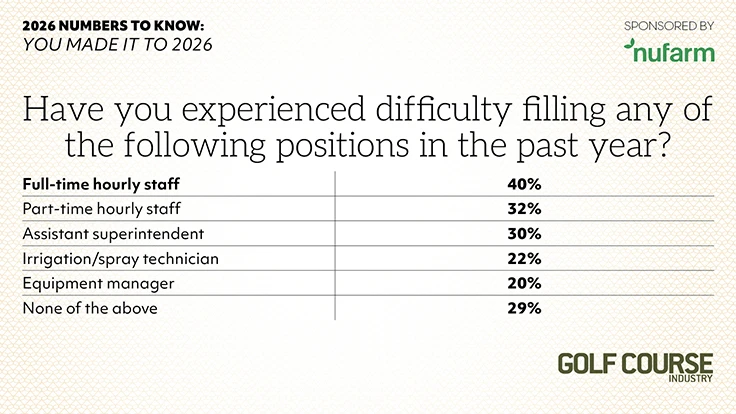
An influx in golf, an abnormal weather season and staffing difficulties makes for an ill-fitting trio. Turf pros all over dealt with one — or all of them — in 2025. Holding consistent staff is an issue plaguing the turf world right now. Superintendents are having a hard time maintaining and attracting staff.
“It’s a pretty competitive market right now with golf courses compared to landscape companies; their rate of pay is higher,” Johnsons says.
To adapt to staffing problems, Johnson has worked with his team to allow for more flexible schedules for the maintenance crew.
“We have six guys that probably work three or four days a week, and one guy comes only for the summers, on Friday and Saturday nights, and does range maintenance,” Johnson says. “A lot of the guys have another primary job. Anybody that can’t work five days a week, we’ll find a way to make it work if they’re worthwhile.”

Despite staffing issues, Johnson says he’s learned how to handle things. He needed to make staffing changes during the financial crisis of 2008 and ensuing Great Recession. When the facility had to close for six weeks in 2020 because of COVID-19, the team shrunk. Those experiences helped him learn how to adapt, and he will have those skills in his back pocket for the future.
During stretches where work can be tough to handle, Johnson has a plethora of people to lean on. Three of his sons work in the industry, providing an outlet for comfort and advice.
“It’s nice to talk to them and see what they’re going through,” Johnson says. “They always have some good ideas. Their generation has a lot more information coming at them compared to what I had when I started.”
Johnson also turns to other superintendents, both from nearby courses and others within KemperSports, which manages Chambers Bay. “There’s always plenty of support within our company,” he says.
2025 required adaptability from superintendents everywhere. Although Washington didn’t have as intense of a weather year, Johnson and his team have faced challenges in other ways. The superintendent’s adaptability is one way he got through.
— Kelsie Horner

Explore the January 2026 Issue
Check out more from this issue and find your next story to read.
Latest from Golf Course Industry
- VIDEO: Fun with fairways
- From the publisher’s pen: Humble giving
- Syngenta adds two to western U.S. team
- The Aquatrols Company introduces soil surfactant for Canada
- Bernhard and Company partners with Turf Equipment and Supply Company
- Rain Bird announces pair of partnerships
- The Links at Spanish Bay unveils redesign plans
- Westbrook CC picks Troon