sponsored by


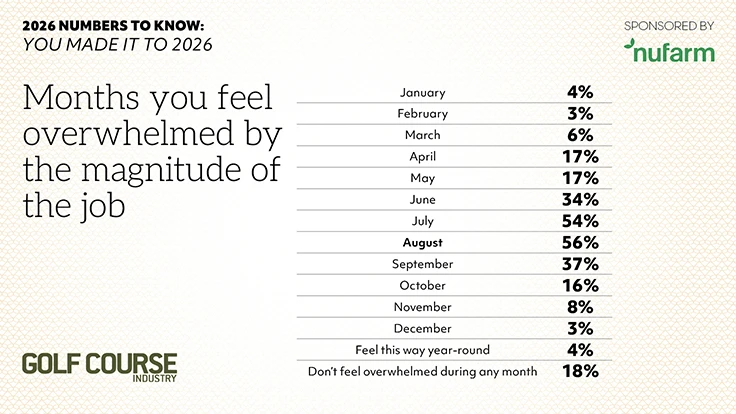
Week after glorious week, rain poured down on Marshall Country Club. Where so many other courses scattered around southern Michigan remained dry, the 18 holes along Lyon Lake received half an inch or more every week from the start of the season, to Memorial Day, through the Fourth of July, into the first days of August.
“We didn’t really need to use our irrigation system at all until August,” superintendent Joshua Coles says. “It made life easier. I didn’t have any real explosions where it was so wet that we couldn’t do anything or we couldn’t control the growth or anything. Mother Nature made it much simpler than in years past. The whole time, I’m thinking, What’s coming next? Because it’s too good to be true. I was dealing with a little more disease than normal because it was a little wetter. But it was too good to be true.”
Marshall Country Club is one of three golf courses in Marshall, Michigan — population: 6,822 — located about 30 miles north of the Indiana-Ohio state border. It’s also situated in “a weird, little valley,” Coles says, that often delivers weather far different from whatever neighboring cities receive. Throughout the first four months of the 2025 golf season, that was a good thing. Sure, Coles was working through a little more disease pressure than normal, especially summer patch in fairways and dollar spot on greens, but that seemed a small price to pay for not turning to the irrigation system for more than two straight days through early August.
Over the last three or four months, though, it was not.
The rain stopped. The drought that so many other folks had already endured hit Coles hard.
“From the last week of July, the lake that we pull from, we lost almost three feet of static water depth,” Coles says. “I had a foot of water left to pull from with a month to go. We got into the 90s quite a few days there, 40 percent humidity, and we were losing two inches a day from our lake just because of evaporation. Before we knew it, we were starting to pull from the bottom of the lake. Our heads were clogged up, our pumps are going down. I was out there every night, making sure the pump wasn’t clogged up with soot and mud from the bottom of the lake. We started to see some decline in the turf at that point.
“Every day, I just went out and cleaned around the intake, and we got a couple of rains. That got us through. We were two weeks away from being in a very bad position if we had gone any longer than we did and actually needed the water.”
The winter provides its own challenges: During Coles’ 13-season run, Marshall Country Club has transitioned to a public course and equity membership has dropped from about 175 to 50. There are still about 175 total members, but the club is not financially able to keep him working full time through the winter. He works in the shop, grinds with one or two other team members, but there is no winter course maintenance. He normally starts prepping equipment and the turf around March 1 in anticipation of an April 1 opening. His compensation does include housing “right next door,” but that doesn’t help him fill out his team of about 10. “Most people can’t take those two or three months off.” Thankfully, his assistant Drew Lasky is among those folks who come back season after season. So are his parents, Connie and Doug. Connie learned how to mow rough. Doug helps with oil changes and some more mowing. Most of the members volunteer to help clean up the course in the spring and with other projects throughout the season.
Coles says the job is a perfect fit. He grew up in Marshall and has known most of the members since he was a kid. “I put a lot of hours in,” he says, “but it’s rewarding — helping and pleasing the people I’ve grown up with my entire life.”
Even during the wettest — and driest — of seasons.

— Matt LaWell

Explore the January 2026 Issue
Check out more from this issue and find your next story to read.
Latest from Golf Course Industry
- VIDEO: Fun with fairways
- From the publisher’s pen: Humble giving
- Syngenta adds two to western U.S. team
- The Aquatrols Company introduces soil surfactant for Canada
- Bernhard and Company partners with Turf Equipment and Supply Company
- Rain Bird announces pair of partnerships
- The Links at Spanish Bay unveils redesign plans
- Westbrook CC picks Troon