Let’s reveal a secret gleaned from visiting hundreds of golf courses and reading about a pair of charming facilities in this month’s issue.
No matter how consistent and pure the greens, the tidiness of the fairways, the crispness and freshness of the sandwich lettuce, the quality of craft drinks on tap or shelf, or the creativity on the event calendar, a course must pass the 30-minute test to be viewed favorably among enthusiasts responsible for making golf a $101.7 billion industry. That same test applies to reliable people evaluating potential jobs at a golf course.
What’s the 30-minute test?
Anybody who has visited enough golf courses, in a variety of locations, can tell if a place is worth revisiting, joining and touting within 30 minutes of being on property. This isn’t some AI-generated superpower. Observant individuals with far less golf and travel experience possess the same ability.
Before reaching the signature hole, or perhaps even the first tee, somebody can already tell if they want to spend more time on a property. Consider a golf facility one giant first date. Nasty first impressions yield walkaways and provide gossip material; terrific first impressions lead to longtime loyalty.
I recently visited a popular golf tourist destination with seven friends on a curated golf package booked months in advance. A few weeks before the trip, our group was bumped from a course we were all excited to play because of a business transaction involving the booking company. A tee time booked months ago suddenly vanished, so our group was transferred to another course at a 36-hole facility in a different county. Yes, a total golf-world problem!
From the moment we arrived at the security gate — a totally unnecessary status flaunt given the facility’s remote location — we knew this wasn’t going to be the best Saturday of 2025 like we envisioned. Passing through the gate proved to be a five-minute ordeal, finding the clubhouse/golf shop proved to be another five-minute ordeal, and then listening to somebody in the pro shop tell us everything we couldn’t do during the round proved to be … well … a five-minute ordeal.
Forget the 30-minute test. This facility failed the 15-minute test. Instead of thinking about shot distances and fellowship with friends, I spent the next 5 hours, 15 minutes (pace of play is another one of the facility’s challenges — and for more on the topic, read Tim Moraghan’s June column) pondering how and why an expansive, ambitious golf development entered such a depressing state. Sadly, the course had dead and shaggy turf on key playing surfaces. Separating work thoughts from personal recreation is impossible when your passion and job intersect.
Neither the employees nor the visiting golfers “permitted” on the grounds wanted to be there on a sunny Saturday. Heck, I wanted to ditch the back nine to chill on a patio and sip tasty, calming drinks, but the clubhouse was strictly off limits to visiting golfers. An awful routing and business model offered nowhere to purchase drinks on the course besides a vending machine incapable of accepting cards or cash. Nobody warned us of these golf-world problems and the facility’s website lacked substantive content regarding the experience awaiting golfers.
Here’s a stunner: this facility didn’t make our “Best Courses to Work” rankings.
I’ve never visited top-ranked Whiskey Creek Golf Club like managing editor Matt LaWell, who experienced a magical day with the course’s employees while reporting this month’s cover story. After learning more about Whiskey Creek’s philosophies, I desperately wanted to visit the Maryland course. And I’m not alone. Whiskey Creek is flourishing because it has the right people guiding all levels of its business. Ditto for Independence Golf in Midlothian, Virginia.
Facilities such as Whiskey Creek and Independence Golf prove achieving enduring success requires developing the right team. Employees are reflections of their managers. When a staff neglects to warmly embrace golfers or allows debris to linger on a green or tee box, managers must gaze inward, because existing and potential customers will begin looking elsewhere to spend recreation time and discretionary income. The post-COVID-19 golf spending frenzy won’t last for eternity. Courses executing people-focused management tactics in 2025 will continue to flourish whenever the economy sputters.
Passing the 30-minute test should be easy. Acing the exam involves putting people above all else.
Future employees and customers make quick judgments. Determining a workplace’s culture doesn’t take 5 hours and 15 minutes.
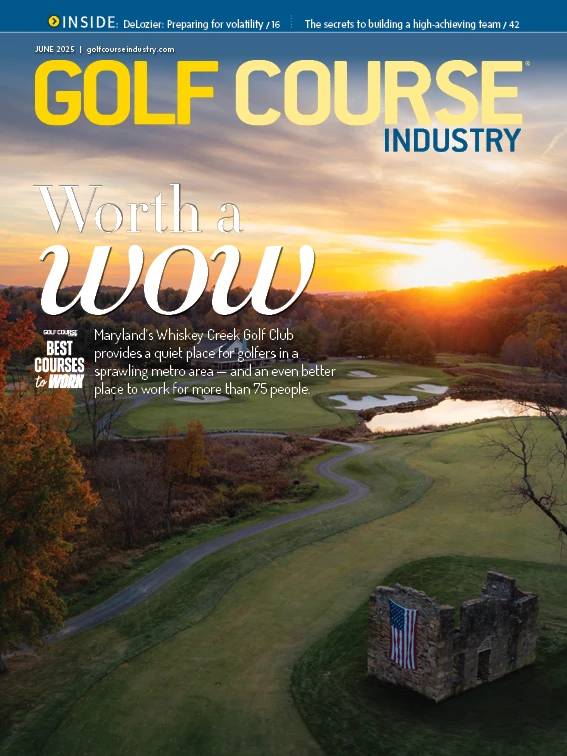
Explore the June 2025 Issue
Check out more from this issue and find your next story to read.
Latest from Golf Course Industry
- VIDEO: 'It's their livelihood'
- Reel Turf Techs: TJ Vollmar
- Bernhard and Company names G.C. Duke as North American Distributor of the Year
- Course at Sewanee picks KemperSports for management
- WiTricity expands wireless charging technology
- Shining star
- SiteOne Landscape Supply acquires Reinders
- Talking Turf Weeds 17: Waking up your course after winter with Yusif Jaouni and Matt Herrmann